“My Landlord Certificate gave me a excellent service. They were very prompt in answering & dealing with all of my 4 properties. Also they are much competitive than other similar firms. Sorted everything with EICR & EPC promptly with 4 of my properties. Will definitely use them in the future and recommend anyone to use their services. You will not be disappointed. Awaiting for my 3 EICR & EPC certificates which will receive today as my Internet was down.
Thank you Asad & Moiz.
Best wishes always.”
Elmhurst Accredited · All 33 London Boroughs · 10-Year Certificate
EPC Certificate from £89.99
from£89.99
Energy Performance Certificate, required by law before renting or selling any residential property in London. Accredited DEA assessors, certificate registered on the national EPC register within 24 hours.
Fixed price · No hidden fees · On the national register within 24 hours

Our engineers are accredited & registered with



What is a domestic EPC?
An Energy Performance Certificate (EPC) is an official government document that rates the energy efficiency of a residential property on a scale from A (most efficient, lowest energy bills) to G (least efficient, highest energy bills). Every EPC also shows the property's estimated current annual energy cost and what those costs could be after recommended improvements are made.

EPCs are produced by accredited Domestic Energy Assessors (DEAs) using government-approved RdSAP (Reduced Data Standard Assessment Procedure) software. The assessment considers a range of factors: the property's construction type (cavity, solid, or timber frame walls), loft and floor insulation levels, window glazing type, the heating system and boiler efficiency, hot water cylinder and controls, and any renewable energy systems such as solar panels. The assessor inputs this data into the RdSAP model, which calculates the SAP (Standard Assessment Procedure) score and corresponding A–G band.
Every EPC also includes a Recommendations Report, a prioritised list of cost-effective improvements specific to your property, with estimated installation costs and projected energy savings. This is a valuable planning tool for landlords who need to improve their rating ahead of tightening MEES regulations. The Recommendations Report is free and included in every assessment we carry out.
Once lodged, your EPC is recorded permanently on the government's national EPC register, accessible to landlords, tenants, letting agents, and mortgage lenders. Prospective tenants, buyers, and letting agents can view the certificate at any time using the property address. The certificate is valid for 10 years from the date of assessment, regardless of changes in ownership or tenancy, unless significant energy-related works have been carried out that would materially affect the rating.
Legal requirement: The Energy Performance of Buildings (England and Wales) Regulations 2012 require a valid EPC to be provided to all prospective tenants before any residential property is marketed to let. Under MEES, properties rated F or G cannot legally be let on a new tenancy. Failure to comply can result in a local authority penalty of up to £5,000.
Coming 2030: The government plans to raise the minimum EPC rating for all private rented tenancies, new and existing, to C from 1 October 2030, subject to legislation. If your property is currently rated D or E, commissioning an EPC assessment and Recommendations Report now gives you time to plan and budget for the required improvements.
EPC ratings A–G explained
The EPC rating is derived from the SAP (Standard Assessment Procedure) score, which estimates the annual energy cost per square metre of floor area. The lower the energy cost, the higher the rating. Most UK homes fall in bands D and E, only around 4% of privately rented homes currently achieve a C or above.
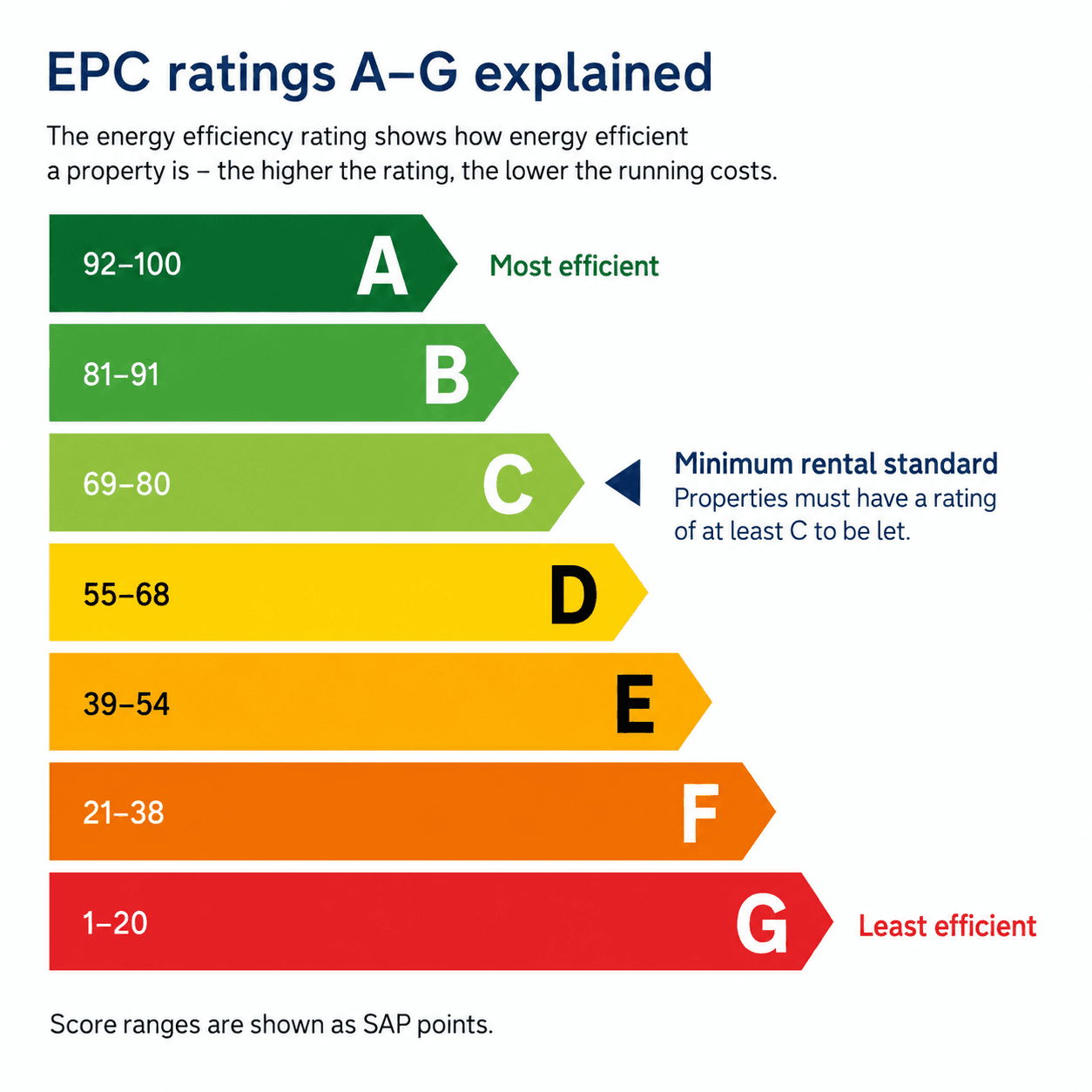
A
92–100 SAPExceptional, very low bills
B
81–91 SAPVery good, low running costs
C
69–80 SAPGood, proposed minimum from 2030
D
55–68 SAPAverage, most UK homes
E
39–54 SAPBelow average, legal minimum
F
21–38 SAPPoor, cannot legally let
G
1–20 SAPVery poor, cannot legally let
Properties rated F or G cannot legally be let on a new tenancy in England. The current legal minimum is E. The proposed minimum from 1 October 2030 for all tenancies is C, subject to legislation.
EPC legal requirements for London landlords
London landlords face a particularly complex compliance landscape around energy efficiency, with obligations imposed by three overlapping pieces of legislation. Understanding all three is essential before marketing a property to let.
1. Energy Performance of Buildings Regulations 2012
Every residential property must have a valid EPC before it is marketed for sale or rent. The EPC must be provided free of charge to prospective tenants and must be attached to any written tenancy agreement. Landlords who fail to provide a valid EPC face a penalty charge of up to £5,000 issued by the local authority. The EPC must be produced by an accredited DEA assessor and lodged on the national register, self-certified or unregistered assessments are not valid.
There are no exemptions for short lets, furnished properties, or properties rented to family members. HMOs where individual rooms are let (rather than the whole property) may be exempt, but this depends on the specific tenancy structure. If in doubt, commissioning an EPC is the safest course of action.
2. Minimum Energy Efficiency Standards (MEES)
The Energy Efficiency (Private Rented Property) (England and Wales) Regulations 2015 introduced MEES, making it unlawful to let a property rated F or G on a new tenancy from April 2018, and on any continuing tenancy from April 2020. Fines for non-compliance are up to £5,000 per property. Properties with an EPC rating of E are currently permitted, but landlords should plan for the proposed increase to C from 1 October 2030, subject to legislation.
Limited exemptions exist, for example, where all cost-effective improvements have been made and the property still cannot reach E, or where a tenant refuses consent for works. Exemptions must be registered on the PRS Exemptions Register and are valid for 5 years. London councils are actively enforcing MEES through proactive inspections and complaint-triggered investigations.
3. Giving tenants the EPC after Section 21
The old rule that a missing EPC blocked a Section 21 notice no longer applies: the Renters’ Rights Act 2025 ended Section 21 “no-fault” evictions in England on 1 May 2026, and possession now needs a Section 8 ground. The EPC duty itself remains. Under the Energy Performance of Buildings (England and Wales) Regulations 2012, you must make a valid EPC available free of charge to prospective tenants at the earliest opportunity, and ensure the person who becomes the tenant is given a copy. A breach for a dwelling carries a £200 penalty charge. Commission your EPC before you market the property, not as an afterthought.
How to improve your EPC rating
Your EPC Recommendations Report lists the improvements most likely to raise your rating, ranked by cost-effectiveness. Below are the nine most impactful measures for London residential properties, together with typical costs and the rating improvement you can expect. All improvements are cumulative, combining several measures will have a larger effect than any single one.
For London landlords targeting the proposed 2030 minimum of C, the most practical path for typical Victorian terraces and purpose-built flats is usually a combination of boiler replacement, loft insulation, and thermostat controls, which can move a D-rated property into band C without the expense of solid wall insulation or renewables.

| # | Improvement | Typical impact | Estimated cost |
|---|---|---|---|
| 1 | Loft insulation (if absent) | +10–15 points | ~£300–£600 |
| 2 | Cavity wall insulation | +8–12 points | ~£500–£1,000 |
| 3 | A-rated condensing boiler replacement | +8–15 points | ~£2,000–£3,500 |
| 4 | Room thermostat + programmer | +3–6 points | ~£150–£400 |
| 5 | Double glazing (if single-glazed) | +5–10 points | ~£4,000–£8,000 |
| 6 | Solid wall insulation (external) | +15–20 points | ~£8,000–£15,000 |
| 7 | Solar photovoltaic (PV) panels | +10–20 points | ~£5,000–£10,000 |
| 8 | Hot water cylinder insulation jacket | +1–3 points | ~£15–£30 |
| 9 | LED lighting throughout | +1–2 points | ~£50–£200 |
Costs and impact estimates are indicative, actual results depend on the specific property. Your EPC Recommendations Report provides property-specific projections.
EPC for different London property types
London's housing stock is unusually diverse, and EPC ratings vary considerably depending on the construction era, property type, and tenure. Here is what landlords should expect for the most common London property types.
Victorian terraces (pre-1919)
Typically D–F
Solid brick walls with no cavity mean wall insulation is the single biggest challenge. Many Victorian terraces rate E or F before improvements. Loft insulation, boiler replacement, and draught-proofing are the most cost-effective starting points.
Purpose-built flats (1960s–80s)
Typically D–E
Concrete construction retains heat reasonably well but older heating systems and single-glazed windows drag ratings down. Boiler upgrades and double glazing can move most 1960s flats from E to C.
New build properties (post-2010)
Typically B–C
New builds are required to meet Part L of the Building Regulations and almost always achieve B or C. EPCs are still legally required before marketing, new build developers lodge the initial EPC as part of the completion process.
HMOs (Houses in Multiple Occupation)
Varies, D–G common
HMOs with shared facilities often have lower ratings due to electric storage heaters, individual meters, and poor insulation. Communal heating controls and insulation upgrades have a significant impact. HMOs rented as a whole require a single EPC; individual room lettings may not.
Converted flats (Victorian/Edwardian)
Typically E–F
Flats carved from period houses often lack roof and wall insulation, and may share a heating system or have electric-only heating. These typically rate E or F and often require the most improvement work ahead of the 2030 changes.
Maisonettes
Typically D–E
Maisonettes assessed as a single dwelling are treated similarly to terraced houses. Those with additional ground-floor heat loss or older heating systems typically sit in the D–E band.
Thorough & accredited
A proper assessment, by an accredited DEA
Your assessor inspects the construction, insulation, glazing, heating system and controls, then lodges your A to G rating on the national register with a free recommendations report showing how to improve it.
- ✓Walls, loft and floor insulation
- ✓Boiler, heating system and controls
- ✓Window glazing and renewables
- ✓Lodged on the national register within 24 hours
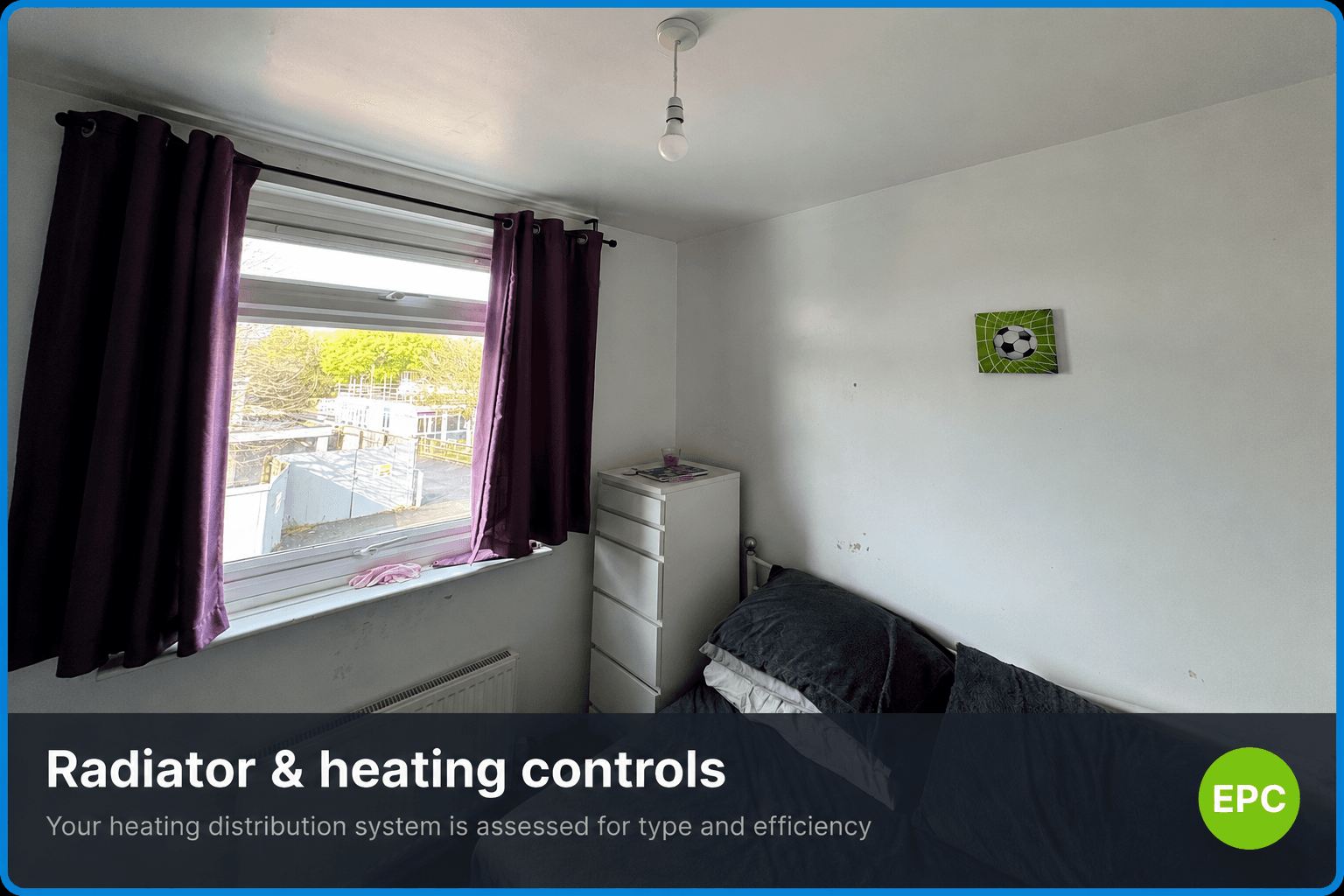
From a recent assessment
See what our assessors actually check
Every EPC involves a thorough room-by-room survey of your property. Here is what a typical visit looks like — real photos from a recent assessment.
Click any image to enlarge · Use arrows to browse
Pricing
Fixed price by property size. Includes on-site assessment and lodgement on the national EPC register.
Domestic EPC
| Description | Price |
|---|---|
| Studio ApartmentCheapest | £89.99Book |
| 1–3 Bedrooms | £109.99Book |
| 4 Bedrooms | £129.99Book |
| 5 Bedrooms | £149.99Book |
Additional charges may apply: Congestion Zone +£20 · Parking restrictions +£10
For commercial properties, see commercial EPC pricing →
What's included from £89.99
- ✓30–60 min on-site assessment by accredited DEA
- ✓Construction type and insulation survey
- ✓Heating system and boiler efficiency assessment
- ✓Hot water system and controls review
- ✓A–G energy efficiency rating (SAP score)
- ✓Estimated annual energy cost breakdown
- ✓Recommendations Report with improvement costs
- ✓Lodgement on national EPC register within 24 hours
- ✓Certificate emailed directly to you
- ✓Certificate valid for 10 years
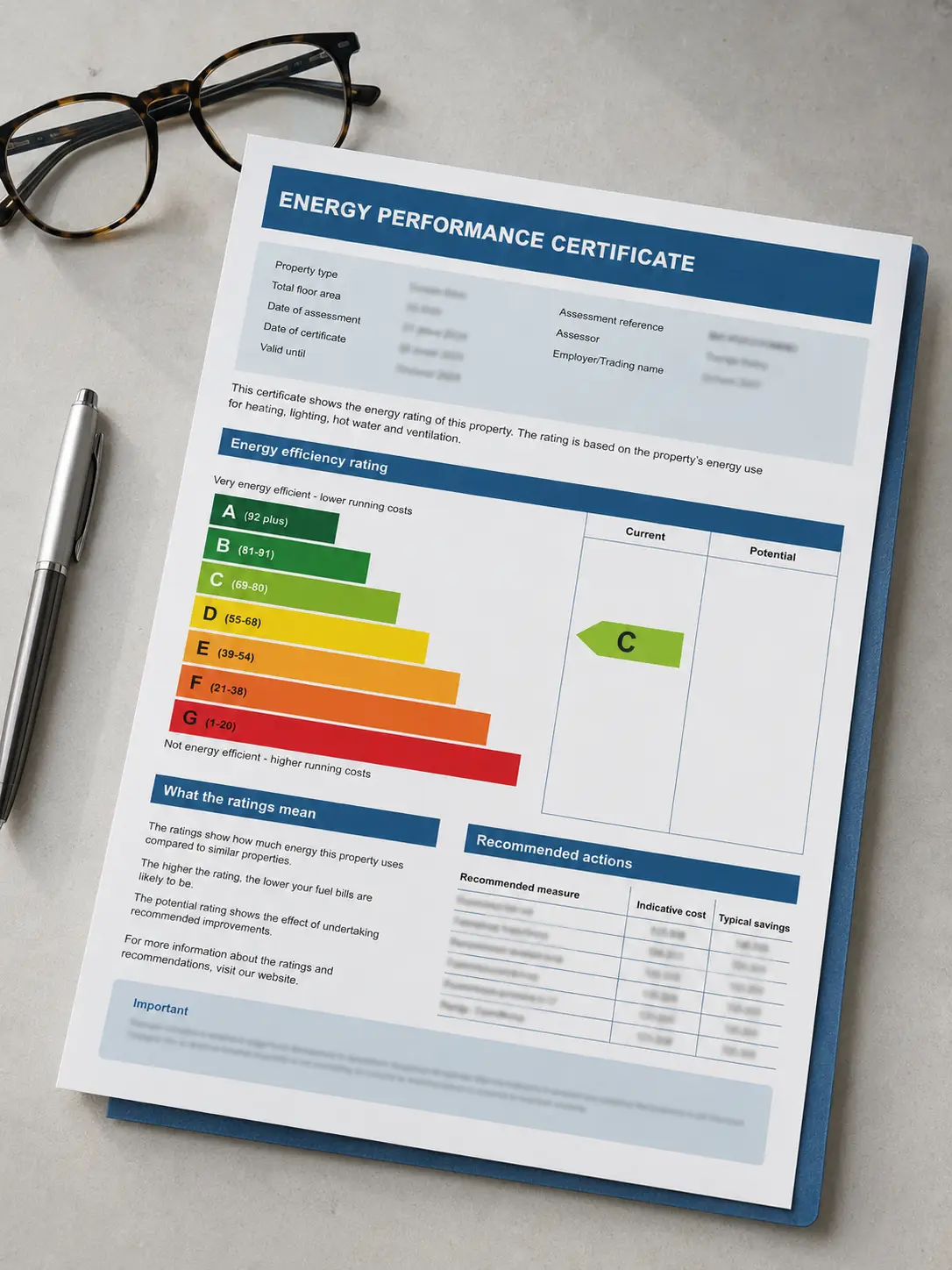
Ready to book your EPC?
Fixed price from £89.99 · on the national register within 24 hours.
How it works

1
Book online or call us
Select your property size, pick a date, and confirm your booking. We cover all 33 London boroughs with same-week appointments available.
2
Assessor visits your property
Our accredited DEA assessor carries out a 30–60 minute survey of the property's construction, heating, insulation, windows, and energy systems.
3
Certificate registered within 24 hours
Your EPC is lodged on the government's national register. You receive the certificate reference number and a full Recommendations Report by email.
Related services

What London landlords say
“Had our Energy Performance Certificate done with My Landlord Certificate. Easy to book, prompt service and the certificate was issued and lodged on the national register without any hassle.”
Read more reviews from London landlords on our reviews page →
EPC in every London borough
Fixed-price epc, available across all 33 London boroughs. Select your borough for local pricing and availability.
Barking & DagenhamBarnetBexleyBrentBromleyCamdenCity of LondonCroydonEalingEnfieldGreenwichHackneyHammersmith & FulhamHaringeyHarrowHaveringHillingdonHounslowIslingtonKensington & ChelseaKingston upon ThamesLambethLewishamMertonNewhamRedbridgeRichmond upon ThamesSouthwarkSuttonTower HamletsWaltham ForestWandsworthWestminster
Frequently Asked Questions
Areas we cover
EPC assessments across all 33 London boroughs. Select your borough for local pricing, coverage and booking.
Barking & DagenhamBarnetBexleyBrentBromleyCamdenCity of LondonCroydonEalingEnfieldGreenwichHackneyHammersmith & FulhamHaringeyHarrowHaveringHillingdonHounslowIslingtonKensington & ChelseaKingston upon ThamesLambethLewishamMertonNewhamRedbridgeRichmond upon ThamesSouthwarkSuttonTower HamletsWaltham ForestWandsworthWestminster
Find us
My Landlord Certificate, 134 Merton High St, London SW19 1BA. Accredited DEA assessors covering all 33 London boroughs and the surrounding M25 area.
Book your EPC assessment today
Fixed price from £89.99. Accredited DEA assessors across all 33 London boroughs, certificate registered on the national EPC register within 24 hours.