“Smoke and heat alarms inspected and certified professionally. Engineer was punctual and knew exactly what he was doing. Certificate received promptly afterwards.”
Fire Safety Certificate London from £54.99
Landlord smoke, heat and carbon monoxide alarm testing and certification across all 33 London boroughs — compliant with the Smoke and Carbon Monoxide Alarm Regulations 2022 and tested to BS 5839-6.
from£54.99
Accredited engineers · Annual testing to BS 5839-6 · Certificate issued within 24 hours
Our engineers are fire-safety accredited

Smoke and heat alarm testing for London landlords
A Fire Safety Certificate confirms that all smoke alarms, heat alarms, and carbon monoxide detectors in your London rental property have been tested and are functioning correctly. It is required as part of HMO licence conditions across all London boroughs, and strongly recommended for all landlords as evidence of ongoing compliance.
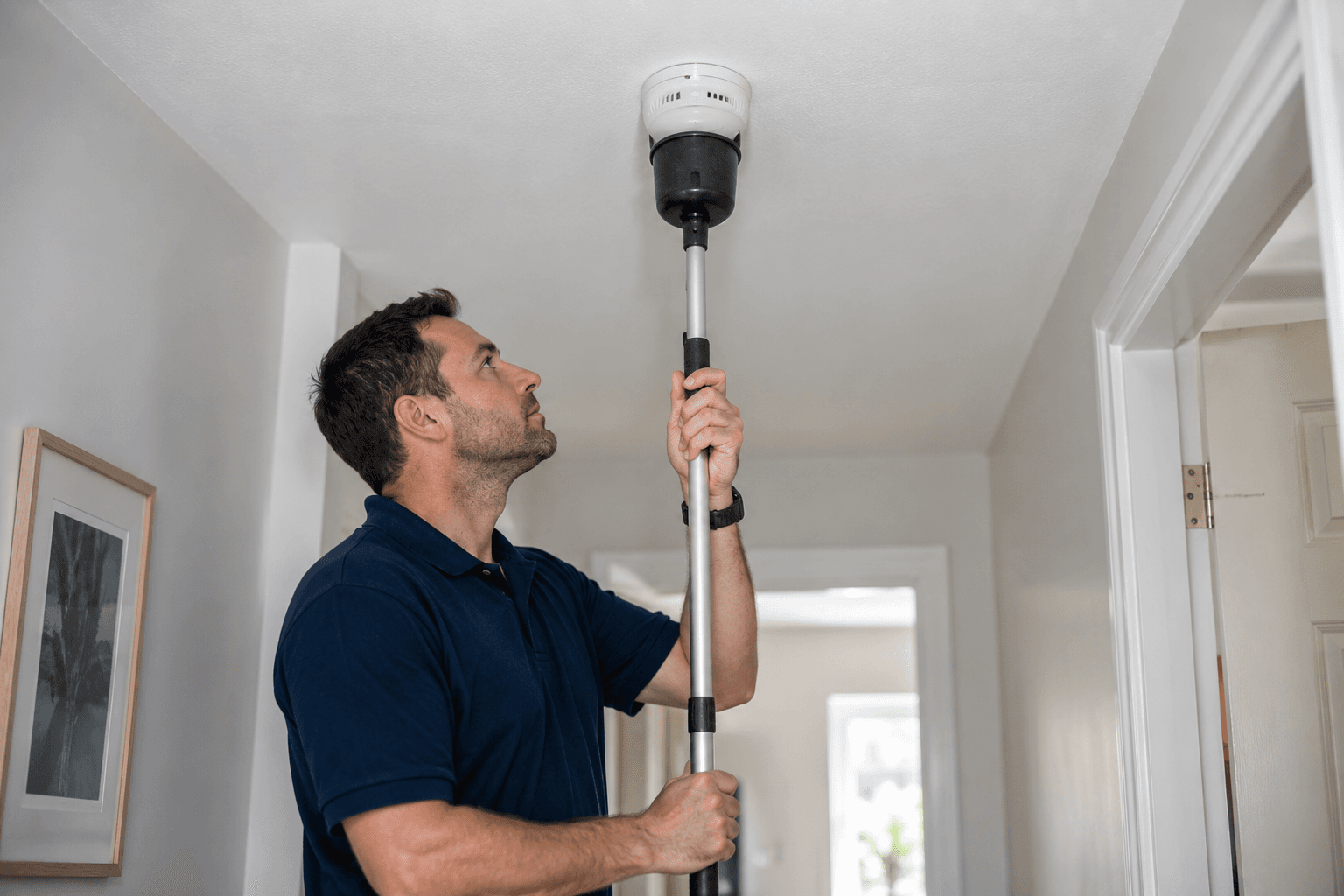
Our accredited engineers test every alarm using a calibrated aerosol test spray, not just a button press, which confirms the optical or ionisation sensor is responding correctly to simulated smoke particles. We check battery condition, manufacture dates, and positioning compliance against BS 5839-6. The written certificate lists every alarm with its test result.
Legal requirement: The Smoke and Carbon Monoxide Alarm (Amendment) Regulations 2022 require all private landlords to install smoke alarms on every storey and CO alarms in every room with a combustion appliance. Annual testing is required for HMO licences and as evidence of due diligence.
Ready to book your fire safety certificate?
Fixed price from £54.99 · certificate emailed within 24 hours · all 33 London boroughs.
How it works
1
Book with your alarm count
Tell us how many smoke, heat, and CO alarms you have. We confirm the price, book your appointment, and arrive at the agreed time, no need for you to be present if a tenant can provide access.
2
Aerosol test of every alarm
Our engineer tests each alarm using calibrated aerosol spray, checks battery condition and manufacture date, and confirms correct positioning per BS 5839-6. CO detectors are also tested at no extra charge.
3
Certificate emailed within 24 hours
You receive the written Fire Safety Certificate listing every alarm with its test result. Keep it with your compliance file and submit it to your local authority or HMO licensing body if requested.
Why landlords choose us
Compliant, fast and landlord-ready
A legal requirement
Under the Smoke and Carbon Monoxide Alarm (England) Regulations 2015 (amended 2022), landlords must fit at least one smoke alarm on every storey and a carbon monoxide alarm in any room with a fixed combustion appliance, and make sure they work.
Accredited engineers
Every alarm is tested by a trained, fire-safety accredited engineer, so your certificate stands up with tenants, letting agents and councils.
Certificate in 24 hours
You receive a clear certificate confirming your smoke, heat and CO alarms are present and working, ready for your records and your tenants.
Fixed price, all boroughs
The price you see is the price you pay. No call-out charges. Same-week appointments across all 33 London boroughs.
Pricing
Fixed price by number of smoke and heat alarms. CO detectors included in same visit.
Fire Safety Certificate
| Description | Price |
|---|---|
| Up to 3 Smoke/Heat AlarmsCheapest | £54.99Book |
| 3–6 Alarms | £89.99Book |
| 6–9 Alarms | £124.99Book |
| 9–12 Alarms | £159.99Book |
| 12–15 Alarms | £194.99Book |
| 15–18 Alarms | £229.99Book |
| 18–21 Alarms | £264.99Book |
Additional charges may apply: Congestion Zone +£20 · Parking restrictions +£10
What's included for £54.99
- ✓Aerosol test of each smoke and heat alarm
- ✓Battery condition check
- ✓Manufacture date and replacement advice
- ✓Positioning check per BS 5839-6
- ✓CO detector testing if present
- ✓Written Fire Safety Certificate
- ✓Pass/fail for each individual alarm
- ✓Certificate emailed within 24 hours
From a recent London job
Real photos from our engineers. Click any image to enlarge.
Click any image to enlarge · Use arrows to browse
Smoke detectors vs heat detectors, which does your property need?
Not all detectors are the same. Using the wrong type in the wrong location causes either missed fires or nuisance alarms, which leads tenants to remove batteries. Here is what each type does and where it belongs.
Optical (photoelectric) smoke detector
- How it works
- A light beam inside the chamber is scattered when smoke particles enter. The scattered light triggers the alarm.
- Best for
- Slow, smouldering fires, burning furniture, overheating wiring
- Recommended in
- Living rooms, bedrooms, hallways
- Avoid in
- Kitchens and bathrooms, cooking steam and shower steam cause frequent false alarms
Ionisation smoke detector
- How it works
- A tiny amount of radioactive material ionises air in the detector. Smoke disrupts this ionisation and triggers the alarm.
- Best for
- Fast, flaming fires, burning paper, fast-spreading fires
- Recommended in
- Hallways (less common today, being replaced by optical and multi-sensor types)
- Avoid in
- Kitchens, more prone to false alarms from cooking than optical types
Heat detector, fixed temperature type
- How it works
- Triggers when air temperature reaches a preset level (typically 58°C or 90°C). Unaffected by cooking fumes.
- Best for
- Kitchens, garages, and utility rooms where cooking smoke or steam is present
- Recommended in
- Kitchens, utility rooms, garages
- Avoid in
- Sleeping areas, slower to respond than smoke detectors and must not be the sole alarm on escape routes
Multi-sensor detector
- How it works
- Combines optical smoke sensing, heat sensing, and sometimes CO sensing. Intelligent processing reduces false alarms while improving genuine fire detection.
- Best for
- General installation in modern systems, fewer false alarms, better detection
- Recommended in
- Any room, particularly useful near kitchens and in HMOs where false alarms are a persistent issue
Understanding fire alarm system categories (BS 5839)
All fire alarm systems in the UK must comply with BS 5839. The standard defines system categories based on their purpose and coverage. The category required for your property is specified by the fire risk assessment, here is a plain-English reference:
| Category | Coverage | Typical use |
|---|---|---|
| Category M | Manual call points only, no automatic detection | Small commercial premises |
| Category L3 | Automatic detection on escape routes only | Basic HMO, block of flats communal areas |
| Category L2 | Escape routes plus high-risk areas (kitchens, plant rooms) | Larger HMOs, offices, hotels |
| Category L1 | Full building detection in all areas | Hospitals, care homes, high-risk buildings |
| Grade D (domestic) | Mains-powered with battery backup, individual interlinked units. No central panel. | Single-family homes, simple HMOs |
For most residential HMOs: A Grade D, Category LD2 or LD3 system (as defined in BS 5839 Part 6 for domestic premises) is required as a minimum. The exact requirement depends on the property layout and number of occupants, your fire risk assessment will specify what is needed for your specific building.
How to test and maintain your fire detection system
A fire detection system that is never tested gives false confidence. Here are the required testing intervals and what each involves.
Weekly
Test button check
Trigger one call point or test button to confirm the alarm sounds correctly. Rotate around all devices over time so every alarm is tested periodically. Log every test in a fire log book, this record is inspected during HMO licence renewals.
Monthly
Panel inspection
Visually inspect the control panel (if fitted) for fault indicators. Confirm all status lights are normal and no battery warning lights are showing. Record in the fire log book.
Annual
Full engineer service
A qualified fire alarm engineer must service the entire system once a year. The service covers: testing every detector individually, testing every call point, checking all sounders and visual alarms, inspecting cables and connections, checking battery charge levels, and updating the logbook. An Annual Fire Alarm Service Certificate is issued after this visit, this is separate from the Fire Safety Certificate issued after a fire risk assessment.
Insurance warning: Failure to service the system annually does not just create a compliance gap, it can void your property insurance if a fire occurs. Many insurers require evidence of annual fire alarm servicing as an explicit policy condition. Keep your Annual Fire Alarm Service Certificate alongside your Fire Safety Certificate and fire risk assessment.
What London landlords say
Fire Safety Cert in every London borough
Fixed-price fire safety cert, available across all 33 London boroughs. Select your borough for local pricing and availability.
Barking & DagenhamBarnetBexleyBrentBromleyCamdenCity of LondonCroydonEalingEnfieldGreenwichHackneyHammersmith & FulhamHaringeyHarrowHaveringHillingdonHounslowIslingtonKensington & ChelseaKingston upon ThamesLambethLewishamMertonNewhamRedbridgeRichmond upon ThamesSouthwarkSuttonTower HamletsWaltham ForestWandsworthWestminster
Frequently Asked Questions
Related services
Need fire alarm installation?
We also install mains-wired interlinked smoke and heat alarm systems, from £3499 for a full system or £209.99per alarm (supply & install). BS 5839-6 compliant with commissioning certificate included.
View fire alarm installation prices →Book your Fire Safety Certificate
Fixed price from £54.99. Accredited engineers, certificate within 24 hours. Same-week appointments across all 33 London boroughs.
Book Now, from £54.99