“I’ve now used this company four times and can honestly say they’ve been brilliant from start to finish.
I originally found them after being let down repeatedly by another company (to the point where I’m now having to take legal action), so I was understandably very nervous about using someone new. I’m so glad I chose them.
They’ve carried out EICRs, Fire Risk Assessments, a substantial package of follow-on fire safety works, and I’ve now booked them again for another Fire Risk Assessment, EICR and an Asbestos Management Survey.
Every member of the team has been incredibly responsive, professional and helpful. They’re always happy to answer questions, no matter how many you have, and they never make you feel like you’re a burden. Communication has been excellent throughout, which is something I really value.
On the larger follow-on works, they initially quoted two days to complete the job but actually finished it in just over one day, which was a fantastic surprise. Although I wasn’t present during the Fire Risk Assessment at one of the blocks, one of the directors there commented on how friendly and helpful their surveyor was. One of my own team members, who met him on site, said exactly the same.
Overall, I’m genuinely impressed with the quality of their work, their professionalism and how easy they are to deal with. They’ve gone above and beyond on every project we’ve given them, and they’ll continue to be my first choice for compliance work. I wouldn’t hesitate to recommend them.”
IFSM Certified Assessors · IFE Registered · London & M25
Fire Risk Assessment from £74.99
Compulsory for all HMOs under the Regulatory Reform (Fire Safety) Order 2005 and strongly recommended for all rental properties. NEBOSH qualified assessors. Written report with prioritised action plan emailed within 24 hours of the inspection.
from£74.99

Our engineers are fire-safety accredited

IFSM certified fire risk assessors
Our fire risk assessors are certified members of the Institute of Fire Safety Managers (IFSM), the leading professional body for fire risk assessment in the UK. IFSM membership requires demonstrated competence in fire safety management, ongoing professional development, and adherence to a strict code of ethics. It is not a qualification that can be purchased or obtained by attending a short course , it requires evidence of practical experience, technical knowledge, and a commitment to continuous professional development that is reviewed regularly.
The IFSM is recognised by the UK Government, the Home Office, and local fire and rescue services as the benchmark for fire risk assessor competence. When your fire risk assessment is carried out by an IFSM certified assessor, it carries the weight and credibility that local authorities, insurers, and the courts recognise as the gold standard, not simply a piece of paperwork, but a document produced by a demonstrably competent professional.
Our assessors also hold qualifications from the Institution of Fire Engineers (IFE) and carry NEBOSH Fire Safety and Risk Management certificates. This combination of professional memberships and technical qualifications means your assessment is carried out to the highest standard available, not by a general health and safety consultant who happens to offer fire risk assessments as a side service, but by specialists whose entire professional focus is fire safety.
Why IFSM certification matters for your fire risk assessment: Local councils and housing tribunals in London specifically look for fire risk assessments carried out by competent persons. IFSM certification is the clearest way to demonstrate competence under Article 9(3) of the Regulatory Reform (Fire Safety) Order 2005, which requires that the responsible person appoints a "competent person" to assist with fire safety measures. An assessment carried out by an unqualified or uncertified person can be challenged in court and may leave you personally liable, even if you genuinely believed the assessor was qualified.
What our fire risk assessment covers
A fire risk assessment is not a checklist, it is a professional judgement about the specific fire risks in a specific building at a specific point in time. Our IFSM certified assessors examine fourteen areas in every residential and HMO assessment.
The assessment begins with means of escape. Every escape route is walked and judged against the likely travel distances and the number and vulnerability of occupants. Corridor widths, final exit door mechanisms, obstructions, and the adequacy of signage are all evaluated. In HMOs and blocks of flats, the assessor considers whether occupants on upper floors could become trapped if the ground floor route is compromised, and whether there are adequate alternative escape routes or refuge areas.
Fire detection and warning systems are tested and assessed for adequacy relative to the size and layout of the property. This includes checking whether detectors are interlinked, whether the correct type is installed in each location, heat detectors in kitchens, smoke detectors in corridors and bedrooms, and whether the system has been tested and serviced within the required intervals. Emergency lighting is assessed for coverage, duration, and maintenance records, with particular attention to escape route illumination following a mains failure.
Fire door condition is assessed in detail. The assessor checks each door for closing mechanisms, gap tolerances (no more than 3mm at the head and sides, 8mm at the floor), intumescent strip and cold smoke seal integrity, vision panels, and whether doors are being propped open. Compartmentation, the fire-resisting construction that contains a fire within a defined area, is checked at walls, floors, ceilings, and around service penetrations such as pipes and cables, where unsealed holes are one of the most common serious findings.
Arson risk is assessed from the outside as well as the inside. Bin stores adjacent to the building, accessible voids, and external storage of combustible materials are evaluated as arson opportunities. Management procedures are reviewed, who is designated as the responsible person, what written procedures exist, whether tenants have been briefed on evacuation, and whether maintenance logs and previous assessment records are available.
Resident vulnerability is considered throughout the assessment. A property occupied by elderly residents, people with mobility impairments, or those with cognitive conditions requires a fundamentally different approach to evacuation planning than one occupied by young professionals. The assessor notes any Personal Emergency Evacuation Plans (PEEPs) that may be required and flags these in the report.
The assessment also covers electrical sources of ignition, including any evidence of overloaded sockets, damaged wiring, or appliances left unattended, gas appliance and kitchen arrangements, storage of flammable liquids or materials, fire action notice provision and legibility, and fire extinguisher type, location, and maintenance status. Every finding is documented, risk-rated, and included in the written report with a recommended remediation timescale.
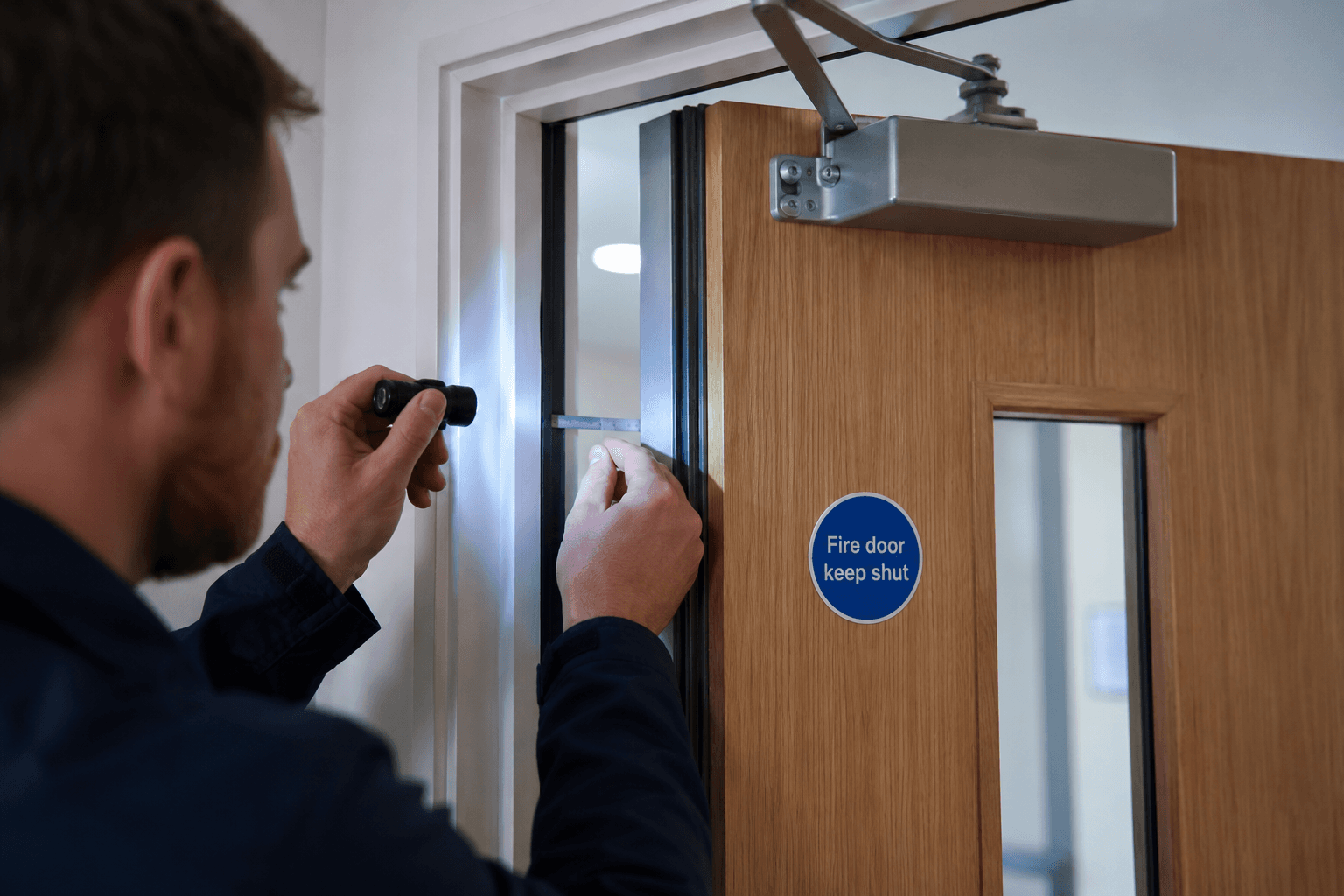
A proper inspection
Every fire-safety measure, checked
Your assessor works methodically through the building and its communal areas, rating each hazard and setting out exactly what needs to happen.
- ✓Fire doors, seals and self-closers
- ✓Detection, alarms and emergency lighting
- ✓Extinguishers, signage and escape routes
- ✓Electrical, storage and housekeeping hazards
From a recent London fire risk assessment
Real photos from a fire risk assessment in a London block. Click any image to enlarge.
Click any image to enlarge · Use arrows to browse
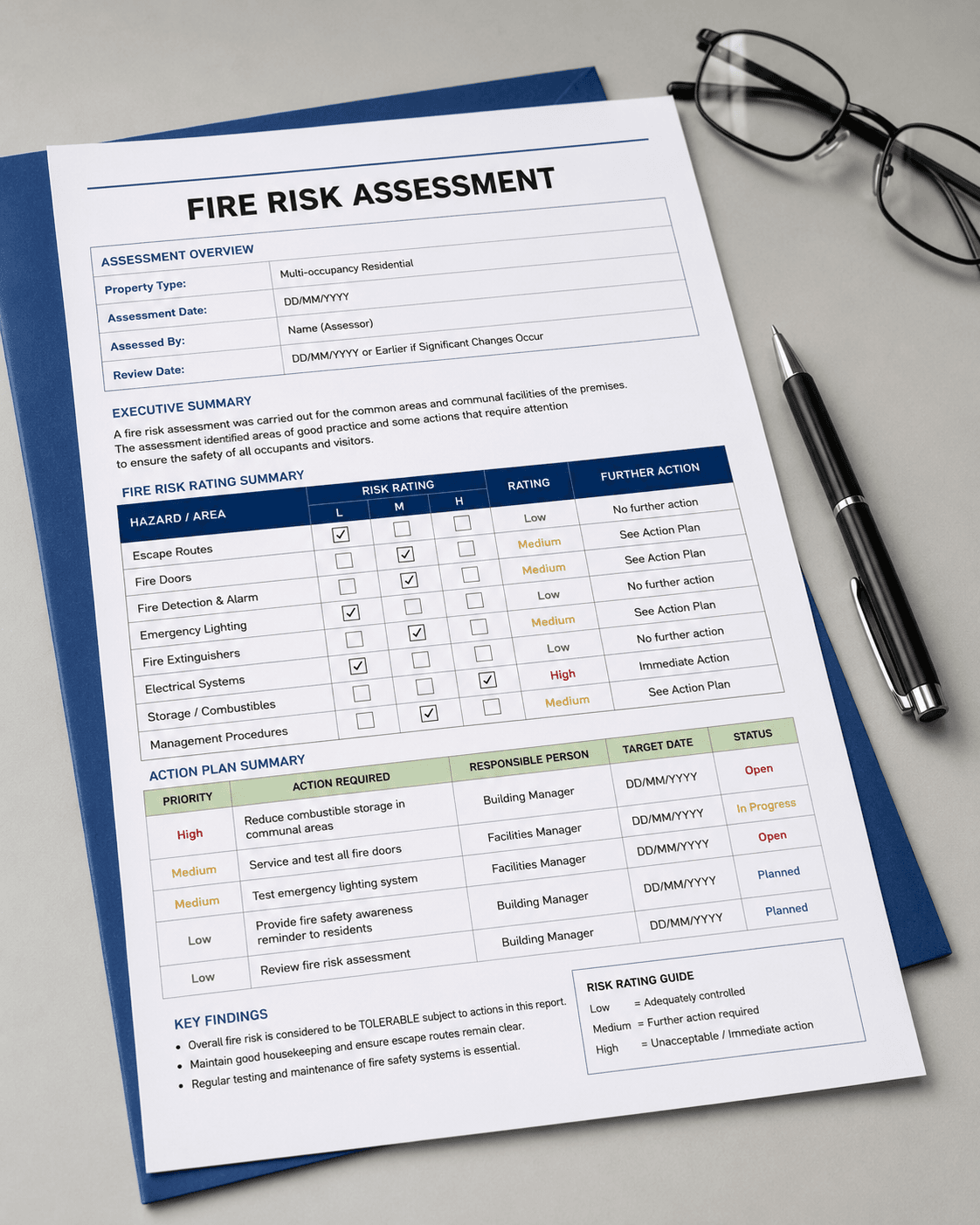
What you get
A clear, council-ready report
- ✓Written fire risk assessment report
- ✓Risk rating for every hazard area
- ✓Prioritised action plan with timescales
- ✓Responsible-person guidance
- ✓Recommended review date
What happens after your fire risk assessment
The assessment itself is the inspection, the value is in what comes next. Here is exactly what you receive and what the process looks like from inspection to compliance.
- 1
Written report emailed within 24 hours
Your full fire risk assessment report is emailed within 24 hours of the inspection. It is a formal written document, not a template with ticks in boxes, that describes the specific conditions observed in your property, references the applicable legislation and guidance, and provides the evidence base for every finding. It is accepted by all London local authorities, fire and rescue services, and HMO licensing teams.
- 2
Prioritised action plan — critical items first
Every finding in the report is given a risk rating: critical (immediate risk requiring immediate action), significant (action required within 3 months), moderate (action required within 6 months), or advisory (recommended improvement with no fixed timescale). The action plan is ordered from highest to lowest priority, so you and your managing agent know exactly what needs to happen first.
- 3
Recommended timescales for every remediation
Each action in the plan carries a recommended completion date. Where a matter is urgent — a propped fire door or a blocked escape route — this will be immediate or within 24 hours. Longer-term improvements such as a smoke detection upgrade or compartmentation works will have a realistic timeframe based on the severity of the risk.
- 4
A responsible person identified for each action
The report names or describes who should be responsible for each corrective action, whether that is the landlord, the managing agent, the resident, or a specialist contractor. This removes ambiguity and gives managing agents a clear instruction document to work from without further interpretation.
- 5
We can carry out remedial work ourselves
Where the report identifies works that need to be done, we can carry these out directly, fire door installation and replacement, fire alarm upgrades and interlinked detection systems, emergency lighting installation, fire extinguisher supply and servicing, compartmentation sealing of service penetrations, and fire safety signage. Having the same team carry out the assessment and the works ensures that the remedial action directly addresses the specific findings.
- 6
Review date set, typically 12 months
The report includes a recommended review date, typically 12 months for HMOs and blocks of flats, or sooner if significant changes are made to the property or its occupants. For lower-risk single lets without communal areas, a 2-year review may be appropriate. We will remind you when your reassessment is due.
What is a Fire Risk Assessment?
A Fire Risk Assessment (FRA) is a structured inspection of a property to identify fire hazards, evaluate who is at risk, and record what actions are required to remove or reduce that risk to an acceptable level. A qualified assessor inspects escape routes, fire doors, smoke and heat detection equipment, ignition sources, and combustible materials throughout the property.
At the end of the inspection you receive a written report detailing every finding, a prioritised action plan, graded into immediate, short-term, and ongoing actions, and a recommended date for reassessment. The report is emailed to you within 24 hours of the visit.
Legal requirement: The Regulatory Reform (Fire Safety) Order 2005 requires a written Fire Risk Assessment for all HMOs and any premises with communal areas shared by multiple occupants. The Renters' Rights Bill 2025 is expected to extend written FRA obligations further. Even where not yet a named legal requirement, your landlord insurance policy is likely to require it, and an FRA is the only recognised way to demonstrate you have met your duty of care.
Legal framework for landlords
Regulatory Reform (Fire Safety) Order 2005
Requires the "Responsible Person" (the landlord or their agent) to carry out a suitable and sufficient Fire Risk Assessment for all HMOs and properties with communal areas. Failure to comply can result in an unlimited fine or up to two years' imprisonment.
Building Safety Act 2022
Introduced for higher-risk buildings (18 metres or 7+ storeys with two or more residential units). Creates new "Accountable Person" duties, a Building Safety Case, and oversight by the Building Safety Regulator. An up-to-date FRA is a core requirement under the Act.
HMO Licence Conditions
Most local authorities include a current Fire Risk Assessment as an explicit condition of the HMO licence. Your licence can be revoked if you cannot produce an up-to-date FRA on inspection. Operating an unlicensed HMO can lead to a civil penalty of up to £40,000 (offences from 1 May 2026) or an unlimited fine on prosecution.
Smoke and CO Alarm Regulations 2022
Require at least one smoke alarm on every floor and a carbon monoxide alarm in any room with a fixed combustion appliance. Our FRA checks compliance and flags any missing or faulty alarms in the written report.
Fire Risk Assessment pricing
Fixed pricing by property type and size. No call-out charges, no hidden fees, the price you see is the price you pay.
Residential Fire Risk Assessment
| Description | Price |
|---|---|
| Studio Apartment | £74.99Book |
| Communal Area (1–3 Floors) | £129.99Book |
| Communal Area (3–6 Floors) | £149.99Book |
| 1–3 BedroomsMost popular | £139.99Book |
| Up to 4 Bedrooms | £179.99Book |
| Up to 5 Bedrooms | £189.99Book |
| Up to 6 Bedrooms | £249.99Book |
| Up to 7 Bedrooms | £299.99Book |
| Up to 8 Bedrooms | £349.99Book |
Additional charges (where applicable)
- Parking charge if no free parking is available on site: £10
- Congestion Charge Zone: £20
Commercial Fire Risk Assessment pricing
For commercial premises, blocks of flats, and larger residential buildings. All commercial assessments are carried out by IFSM certified assessors. Report and prioritised action plan within 24 hours.
Commercial Fire Risk Assessment
| Description | Price |
|---|---|
| Communal Area — Up to 3 Floors | £149.99Book |
| Communal Area — 3–5 Floors | £189.99Book |
| Communal Area — 5–10 Floors | £279.99Book |
| Commercial Building — 1–3 Floors | £249.99Book |
| Commercial Building — 3–5 Floors | £369.99Book |
| Commercial Building — 5–8 Floors | £459.99Book |
| Commercial Building — 8–12 Floors | £539.99Book |
For buildings not listed or complex multi-tenanted premises, call us on 020 3996 1070 for a bespoke quote. Commercial FRA from £149.99.
Comparing all landlord certificate prices? View our complete pricing page →
What's included for £74.99
- Inspection of all escape routes, corridors and stairways
- Assessment of all fire doors and self-closing mechanisms
- Check of smoke and heat detection equipment and carbon monoxide alarms
- Identification of ignition sources and combustible or flammable materials
- Evaluation of fire-fighting equipment (extinguishers, fire blankets)
- Assessment of emergency lighting where fitted
- Written report with findings graded by risk priority
- Prioritised action plan, immediate, short-term, and ongoing actions
- Recommended reassessment date included in the report
Who needs a Fire Risk Assessment?
While HMOs face the strictest legal obligations, any landlord who supplies a rental property has a duty of care to ensure it is fire-safe. Here is how the requirement applies across different property types.
HMOs (Houses in Multiple Occupation)
A written FRA is legally compulsory under the Regulatory Reform (Fire Safety) Order 2005. It is also a condition of the HMO licence in every London borough. Assessments for HMOs cover communal areas, individual rooms, fire compartmentation between units, and the higher risk posed by multiple unrelated occupants. An EICR is also required for all HMOs.
Larger flats and converted buildings
Any building with communal areas, shared hallways, staircases, or landings, falls under the Fire Safety Order. This includes converted Victorian terraces split into flats and any building where two or more tenants share common parts. A separate communal area assessment is required in addition to any individual flat assessment.
Higher-risk buildings (Building Safety Act 2022)
Buildings 18 metres or taller, or with 7 or more storeys and two or more residential units, are now regulated by the Building Safety Regulator. Accountable Persons must maintain a Building Safety Case including an up-to-date FRA, and must engage with residents on building safety matters.
Standard single lets
A written FRA is not yet a named legal requirement for single occupancy properties, but it is strongly recommended, and increasingly required by landlord insurance policies. The Renters' Rights Bill 2025 is expected to bring single lets within the scope of mandatory FRA requirements.
Ready to book your Fire Risk Assessment?
Fixed price from £74.99 · written report within 24 hours.
How it works
- 1
Book online
Choose your property type, select a date, and pay securely online. The whole process takes under 3 minutes. You will receive a confirmation email immediately.
- 2
Assessor visits the property
A NEBOSH qualified fire risk assessor carries out the inspection. You or your tenant can provide access, you do not need to be present. The assessor inspects every relevant area methodically and notes all findings.
- 3
Report emailed within 24 hours
You receive a written Fire Risk Assessment report by email within 24 hours of the visit. The report details every finding, grades each issue by priority, sets out a recommended action plan, and gives a reassessment date.
NEBOSH qualified fire risk assessors
The government does not approve individual fire risk assessors in the same way it approves electricians or gas engineers, but it strongly recommends using a "competent" assessor with appropriate training and experience. NEBOSH, the National Examination Board in Occupational Safety and Health, provides the industry-recognised qualification for fire risk assessors: the NEBOSH National Certificate in Fire Safety and Risk Management.
NEBOSH
National Certificate in Fire Safety & Risk Management
PI Insured
Professional indemnity cover on every assessment
IFSM
Institute of Fire Safety Managers certified assessors
NEBOSH qualifications are recognised by the Health and Safety Executive (HSE), local authorities, letting agents, and landlord insurers as evidence of competence. A NEBOSH qualified assessor produces a report that stands up to scrutiny if your fire safety compliance is ever challenged.
You can verify NEBOSH qualifications via nebosh.org.uk. Read what our landlords say about our assessors on our reviews page.
How a fire risk assessment works, the 5 steps
A Fire Risk Assessment is not a form, it is a structured process defined in UK government guidance. Here are the five official steps and what each involves in a residential setting.
- 1
Identify fire hazards
The assessor inspects every area of the property for: sources of ignition (electrical equipment, gas appliances, portable heaters, smoking areas); sources of fuel (furniture, bedding, curtains, paper, cooking materials, rubbish accumulations); and sources of oxygen (normal air, any oxidising chemicals stored on site).
- 2
Identify people at risk
The assessment considers all occupants, particularly those most vulnerable: sleeping occupants (slower to respond to alarms), people with disabilities or mobility impairments, HMO tenants who may not know each other or the building layout, and any children in the property.
- 3
Evaluate, remove or reduce risk
Based on the hazards and people identified, the assessor evaluates how likely a fire is and how serious the consequences would be. They then recommend: removing the hazard where possible; reducing the risk with fire doors, detection systems or emergency lighting; or documenting the residual risk where it cannot be eliminated.
- 4
Record, plan and communicate
Findings are written up in a formal report covering: all identified hazards, existing fire safety measures, a prioritised action plan (immediate, short-term, ongoing), a recommended evacuation procedure, and any Personal Emergency Evacuation Plans (PEEPs) required for disabled occupants.
- 5
Review and update
The assessment must be reviewed after any fire or near-miss, significant building changes, a change in number of occupants, new activities that introduce new risks, and as a minimum annually. An out-of-date FRA provides no legal protection.
What the assessor looks at in your property
During the site visit, the assessor systematically examines eight areas. Each finding is recorded in the written report with a risk rating and a recommended action.
- ✓
Escape routes
Are all corridors, stairwells and final exits unobstructed, unlocked and clearly signed? A blocked corridor is an immediate risk.
- ✓
Fire doors
Are fire doors self-closing, undamaged, and fitted with intact intumescent seals and cold smoke seals? Propped fire doors are a common and serious finding.
- ✓
Smoke and heat detection
Are alarms fitted in appropriate locations? Are they interlinked? Have they been tested? Are they within their service life?
- ✓
Emergency lighting
Do escape routes have working emergency lights? Has the required 3-hour annual discharge test been carried out and recorded?
- ✓
Fire extinguishers
Are the correct types present, water for general areas, CO₂ near electrical equipment, wet chemical in kitchens? Are they within their annual service date?
- ✓
Ignition sources
Are electrical appliances maintained? Is there evidence of overloaded sockets, damaged cables, or unsafe DIY electrical work?
- ✓
Combustible materials
Is there excessive rubbish accumulation, furniture stored in corridors, or flammable materials stored near heat sources or electrical equipment?
- ✓
Building fabric
Are fire-separating walls and floors intact? Are there unsealed holes around pipes or cables that could allow fire or smoke to spread between floors or units?
Fire extinguisher types for landlords
Using the wrong extinguisher can make a fire significantly worse. Every FRA checks whether the correct types are present. Here is a plain-English guide.
Red labelWater
- For
- Wood, paper, textiles (Class A fires)
- Common locations
- General areas, corridors, communal spaces
- Never use on
- Electrical equipment, cooking oil, gas fires
Black labelCO₂
- For
- Electrical equipment and flammable liquids (Class B)
- Common locations
- Near electrical panels, meter cupboards, IT equipment
- Caution
- Very cold discharge, do not hold the horn directly
Yellow labelWet Chemical
- For
- Cooking oils and fats (Class F, chip pans, fryers)
- Common locations
- Any kitchen with a deep fat fryer or range
- Never use on
- Never substitute water on cooking oil, it causes a steam explosion
Cream labelFoam
- For
- Flammable liquids (Class B) and general Class A fires
- Common locations
- Garages, storage areas, plant rooms
- Never use on
- Electrical equipment (unless rated for electrical use)
HMOs and blocks of flats: Most require at least one water extinguisher per floor and a CO₂ extinguisher near any electrical distribution boards. Any kitchen with cooking equipment requires a wet chemical extinguisher as a minimum. Book fire extinguisher servicing →
Other compliance certificates you may need
Most landlords who need a Fire Risk Assessment also need an EICR and a Gas Safety Certificate (CP12). Book all three together and save with our HMO Complete bundle.
What London landlords say
“Excellent service! I got my Fire Risk Assessment certificate right on time, and the team was incredibly helpful in guiding me through rectifying the issues. The staff was super cooperative from start to finish. Highly recommended”
FRA in every London borough
Fixed-price fra, available across all 33 London boroughs. Select your borough for local pricing and availability.
Barking & DagenhamBarnetBexleyBrentBromleyCamdenCity of LondonCroydonEalingEnfieldGreenwichHackneyHammersmith & FulhamHaringeyHarrowHaveringHillingdonHounslowIslingtonKensington & ChelseaKingston upon ThamesLambethLewishamMertonNewhamRedbridgeRichmond upon ThamesSouthwarkSuttonTower HamletsWaltham ForestWandsworthWestminster
Fire Risk Assessment, frequently asked questions
Want the full legal breakdown? Read our complete guide →
Need fire alarm installation?
We also install mains-wired interlinked smoke and heat alarm systems, from £3499 for a full system or £209.99per alarm (supply & install). BS 5839-6 compliant with commissioning certificate included.
View fire alarm installation prices →Areas we cover
Fire Risk Assessments across all 33 London boroughs. Select your borough for local pricing, coverage and booking.
Barking & DagenhamBarnetBexleyBrentBromleyCamdenCity of LondonCroydonEalingEnfieldGreenwichHackneyHammersmith & FulhamHaringeyHarrowHaveringHillingdonHounslowIslingtonKensington & ChelseaKingston upon ThamesLambethLewishamMertonNewhamRedbridgeRichmond upon ThamesSouthwarkSuttonTower HamletsWaltham ForestWandsworthWestminster
Ready to book your Fire Risk Assessment?
Book online in under 3 minutes. A NEBOSH qualified assessor will contact you to confirm your appointment. Written report emailed within 24 hours of the inspection, from £139.99 for a 1–3 bedroom property.
Book my FRA, from £74.99No hidden charges. NEBOSH qualified assessors. Report emailed within 24 hours.